Properly painting and staining your Andersen® products is essential for long-term care and to maintain coverage under the terms of the Andersen® Owner-2-Owner® Limited Warranty.
Important Information on Painting and Staining Andersen® Products
This article provides you with general guidelines and recommendations for painting and staining your Andersen® products.
This Article Will Help You
- Understand proper guidelines and recommendations for painting and staining Andersen® products.
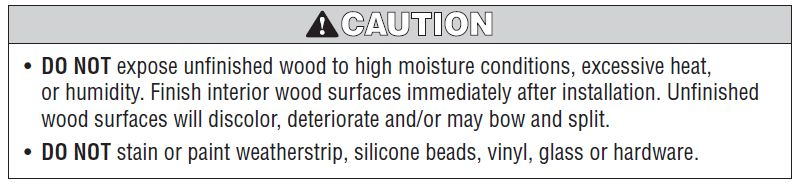
Safety Warning
Let's Get Started
General Guidelines & Recommendations
Guidelines for Storing Newly Purchased Andersen® Products
- If you have purchased a new window or door unit, we recommend finishing the interior wood before storing the product. We do not recommend storing a new product without finishing the interior.
- All window and door units must be finished, sealed, or suitably protected no later than 14 days after arriving at the job site. The interior and exterior of wood surfaces should be finished simultaneously.
- For more information, see Andersen® Windows and Doors Panel and Sash Storage Guidelines.
Guidelines for Finishing Andersen® Products
- Always follow the manufacturer's instructions for paint and stain.
- Window sashes, door panels, and wood unit surfaces are not ready for finishing upon initial receipt. Proper surface preparation is a crucial step in the finishing process.
- Important: Damage resulting from failure to seal the interior wood on your product is not covered under the terms of the Andersen® Owner-2-Owner® Limited Warranty. Finish and/or seal all wood sides and edges of the window sash, door panels, and wood unit surfaces. Seal all exposed wood surfaces, including top and bottom rails, hinge pockets, cutouts, and hardware preps.
- Color variation in wood is a natural characteristic. To compensate for any variation in wood color, adjustments are made during the finishing process to achieve the desired results. Avoid using dark-colored finishes on product surfaces exposed to direct sunlight to reduce the risk of warping or cracking. High-gloss topcoat finishes will accentuate surface imperfections.
- For window sash and door panel surfaces with glass, the finish should overlap the glass by at least 1/16-inch. This will provide a continuous seal between the glass and wood components, helping prevent water penetration. This finish seal must be maintained. If cracks or voids develop, repair them immediately.
- Do not attempt to finish the product in wet weather or at temperatures lower than those recommended by the finish manufacturer.
- Do not paint or stain non-wood parts, including weatherstripping, hinges, locks, other hardware, or exterior cladding.
Guidelines for Painting or Refinishing Surface Materials
Andersen® windows and doors are made from various materials and finishes, depending on the product. Some materials require painting and finishing, while others do not.
Do not paint or apply finishes to the following surfaces, as it will affect the Andersen® Owner-2-Owner® Limited Warranty:
- Fiberglass material
- Flexacron finishes
- Vinyl cladding
- Fibrex® material
- Aluminum cladding
How to Properly Prepare Wood Surfaces
- Allow wood surfaces to dry before starting the finishing process. Wood should have less than 16% moisture content. If necessary, remove and store window sashes or door panels in a temperature- and humidity-controlled environment until the moisture content has equalized and returned to a more normal level.
- Remove all handling marks, raised grain, job site-inflicted scratches and scuffs, and any other undesirable blemishes by thoroughly block sanding all wood surfaces with 220 grit sandpaper.
- Fill all nail and fastener holes as well as any other surface cracks or imperfections using exterior grade wood filler that is compatible with the paint or finish.
- If the unit has a factory-applied primed exterior, proceed to the painting instructions linked below.
- Always sand in the direction of the grain with the folded edge of sandpaper facing the direction of travel to prevent sandpaper from catching under a sliver of wood.
- Remove grease, oil, or pitch. Remove dust with a tack cloth or damp clean rag after sanding.
- Important: Do not use caustic or abrasive cleaners as they may damage the wood.
Related Articles
For specific painting and staining how-to articles, see:
©2026 Andersen Corporation. All rights reserved.